


Where does the Morocco property market stand in 2026? Here is how prices and sales moved, city by city.
If you want to buy or invest in Morocco, you need to know where the market stands. The official figures for the first half of 2026 show a clear pattern: a weak first quarter, followed by a recovery in the second. But the differences between cities are large. In this article we set out the figures city by city and explain what they mean for buyers.
The Morocco property market: key takeaways
- First quarter: a clear slowdown. Nationally, prices fell by 2.4% and the number of transactions by 40.2% compared with the previous quarter.
- Second quarter: recovery. The price index rose by 0.7% and the number of transactions by 11%.
- Tangier recorded the strongest price increase of all major cities in the second quarter.
- Rabat saw the biggest jump in sales.
The figures by city
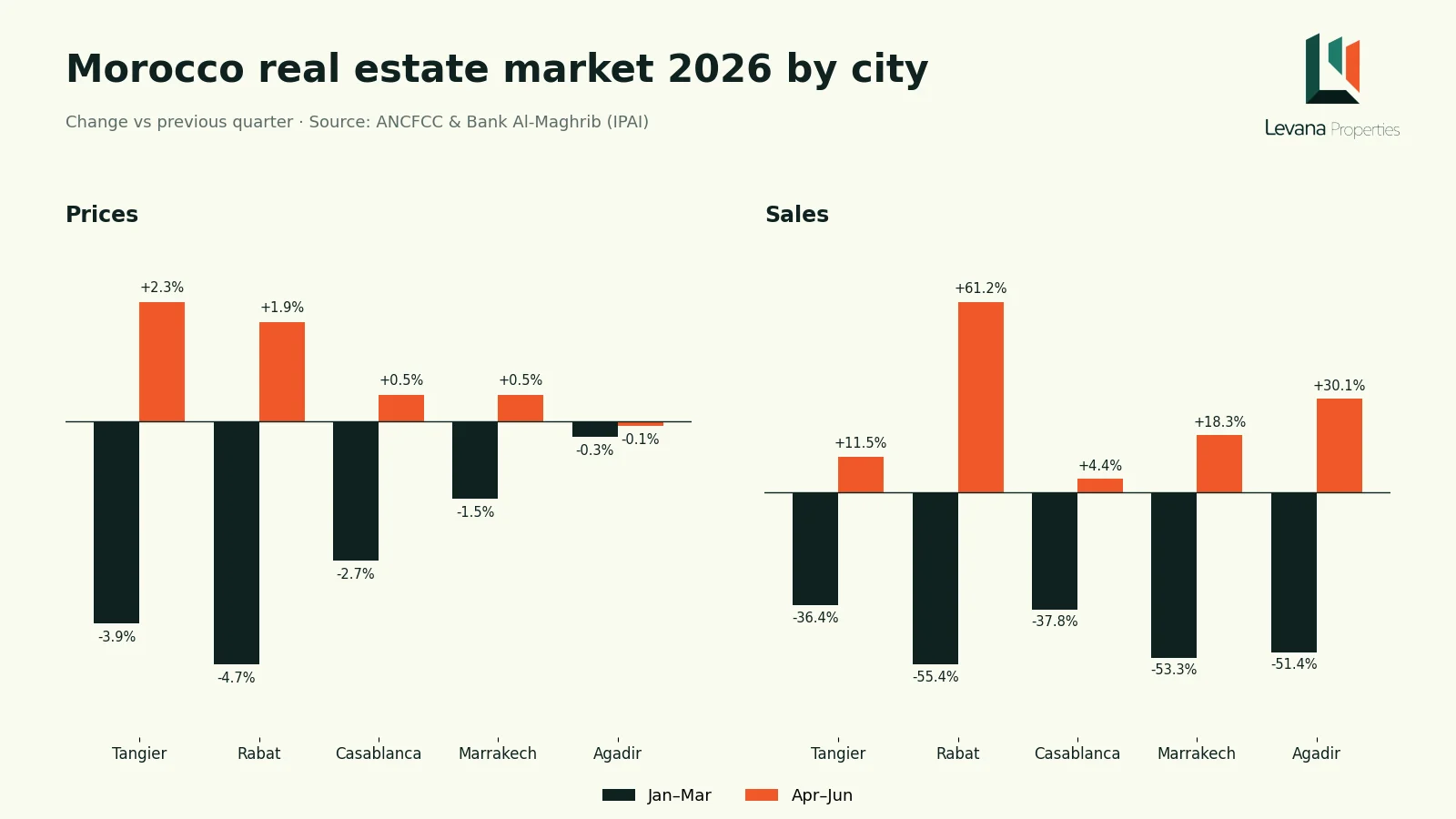
Change compared with the previous quarter.
| City | Prices Jan–Mar | Sales Jan–Mar | Prices Apr–Jun | Sales Apr–Jun |
|---|---|---|---|---|
| Tangier | -3.9% | -36.4% | +2.3% | +11.5% |
| Rabat | -4.7% | -55.4% | +1.9% | +61.2% |
| Casablanca | -2.7% | -37.8% | +0.5% | +4.4% |
| Marrakech | -1.5% | -53.3% | +0.5% | +18.3% |
| Agadir | -0.3% | -51.4% | -0.1% | +30.1% |
First quarter: less dramatic than it looks
In early 2026, headlines spoke of a “collapsing” property market. That is not quite right. Over a full year, prices fell by only 0.4% and sales by 9.3%. The 40% drop in the headlines is a quarterly figure, amplified by seasonal effects and by an exceptionally strong fourth quarter of 2025.
In short: the first quarter mainly came down from a peak. The market slowed, but prices remained fairly stable.
Second quarter: the market picks up again
In spring the picture turned. Year on year, residential prices rose by 1%, land by 0.3% and commercial property by 0.6%. The number of transactions increased by 6.3%. Growth in commercial property, such as shops and offices, stands out in particular.
City by city
Tangier: strongest price growth
Tangier was the standout performer in the second quarter. Price growth was especially strong for land, at 7.3%. Commercial property rose by 4.2% and residential by 0.9%. The number of transactions increased by 11.5%, driven by land sales, which rose by 54.9%. Strong demand for land points to new developments on the way: a sign that the city keeps growing.
👉 Explore our current new-build projects in Tangier.
Rabat: from biggest faller to biggest riser
Rabat had the sharpest decline in the first quarter. In the second quarter, sales jumped by 61.2% across all categories: residential +60.5%, land +50% and commercial property +83.9%.
Casablanca: a cautious recovery
The economic capital is recovering steadily. Prices rose by 0.5% and transactions by 4.4%, with strong increases for land (+41.4%) and commercial property (+29.7%). Residential sales, by contrast, dipped slightly.
Marrakech: clearly more activity
In Marrakech, prices rose by 0.5% and transactions by 18.3%. Land was particularly active, with 37.8% more sales, and residential sales rose by 14.2%.
Agadir: stable prices, volatile sales
Agadir is a special case: prices barely move, while the number of sales fluctuates strongly. In the first quarter prices fell by only 0.3%, but transactions dropped by 51.4%. In the second quarter prices eased by 0.1%, while transactions rose by 30.1%.
Other cities
In the second quarter, prices rose by 1.7% in Fez and 0.7% in Kenitra, fell by 0.9% in Meknes and Oujda, and remained almost stable in El Jadida.
What does this mean for buyers and Moroccans abroad?
- It is still a buyer’s market. In most cities prices rose only slightly. After a weak first quarter there is room to negotiate, especially on off-plan projects.
- Recovery shows up in sales first. More transactions at broadly unchanged prices usually means buyers are returning; price increases often follow later.
- Land as a leading indicator. Strong demand for land in Tangier, Casablanca and Marrakech points to new projects. Those who buy early, at launch prices, benefit most.
- Location remains decisive. A city average says little about a single neighbourhood. Differences within a city are often greater than between cities.
How to read these figures
The figures come from the official real estate price index (IPAI) of Bank Al-Maghrib and ANCFCC, Morocco’s land registry. The index is calculated every quarter using the repeat-sales method, so it only compares properties that have been sold at least twice. Worth knowing: because sales are registered with a delay of a few weeks to a few months, a quarter mainly reflects transactions concluded in the quarter before.
Frequently asked questions
Are property prices in Morocco falling in 2026?
No, not structurally. After a dip in the first quarter, prices rose again in the second quarter in most major cities. Year on year, the price index is slightly higher than a year earlier.
Which city is performing best?
Tangier had the strongest price increase in the second quarter (+2.3%). Rabat had the largest growth in the number of sales (+61.2%).
Is this a good time to buy?
Prices are stable and sales are picking up again. That is often a favourable moment to step in, especially for off-plan new builds. The right choice does depend on the location, the project and your goal: living, renting out or investing.
Stay informed
Want to be the first to hear about new projects and launch prices in Tangier? 👉 Sign up for our new-build alerts. It is free and you can unsubscribe at any time.
Prefer personal advice? Submit a search request and we will select the projects that suit you.
Source: ANCFCC & Bank Al-Maghrib – official real estate price index (IPAI), first and second quarters of 2026.
Sources: Bank Al-Maghrib, ANCFCC (land registry)


